
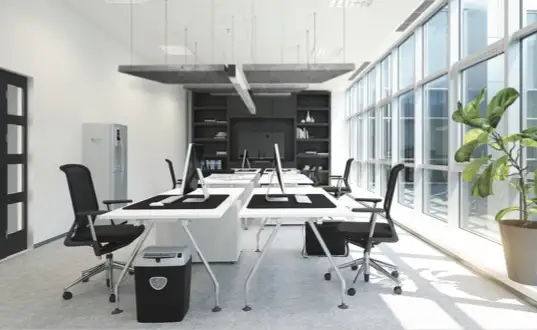
In short: a good reverberation time in an office typically ranges between 0.4 and 0.8 seconds, depending on the type of space: shorter in a phone booth, longer in a representative reception area. The Netherlands does not have a separate legal standard for reverberation time in regular offices (as exists for schools), but international standards NEN-EN-ISO 3382 and ISO 22955 provide the recognized measurement method and guidelines. Below, you’ll find out what these numbers mean, how a measurement works, and when it’s worth the effort.
What is reverberation time exactly?
Reverberation time (also known as RT60) is the time it takes for sound to decrease by 60 decibels in volume after the sound source has stopped. In practical terms: how long a sound lingers in a space after someone has stopped speaking or moving a chair. The harder and smoother the surfaces in a room (glass, concrete, plasterboard), the longer the sound reflects and the higher the reverberation time.
An excessively high reverberation time results in a “hollow” acoustics, persistent background noise throughout the day, and reduced speech intelligibility: you understand a colleague at the other end of the table less clearly, causing people to speak louder and further increasing the noise level.
Is acoustic measurement mandatory in an office?
No, for a regular office in the Netherlands and Belgium, there is no legally mandated post-echo decay time standard like the one that exists for educational spaces. What does apply: the Dutch Work and Safety Act (Arbowet) generally requires employers to provide a work environment that is not harmful to health, and persistent noise nuisance may fall under this if employees report complaints about it. An acoustic measurement is therefore rarely a legal requirement, but it is a practical tool to turn a vague ‘it’s too noisy here’ into a concrete, solvable issue.
A measurement is particularly useful when there are specific complaints about echo or concentration issues, before renovating or reorganizing an office space, or as part of a certification such as WELL or BREEAM, which includes acoustic performance requirements.
What is a good reverberation time? Target values per room type
There is no single universal number: the desired reverberation time depends on the function of the space. In acoustics consulting practice, the following guidelines are typically used:
| Space type | Recommended reverberation time |
|---|---|
| Focus area or concentration zone | approximately 0.3 to 0.4 seconds |
| Open office landscape | approximately 0.4 to 0.6 seconds |
| Small meeting room (up to 10 people) | approximately 0.4 to 0.6 seconds |
| Large meeting room or boardroom | approximately 0.6 to 0.8 seconds |
| Canteen or informal space | approximately 0.6 to 0.8 seconds |
| Entrance or representative reception area | approximately 0.6 to 1.0 seconds |
These values are guidelines from acoustic practice, not strict legal requirements. For smaller or enclosed office spaces, a tighter reverberation time of 0.5 to 0.6 seconds is sometimes applied in practice. More important than the exact number is the balance: too short feels sterile and "dead," while too long causes echo and poor speech intelligibility.
How is reverberation time measured? NEN-EN-ISO 3382 explained
The international standard for measuring reverberation time in ordinary spaces is NEN-EN-ISO 3382-2 (Acoustics, measurement of room acoustic parameters, part 2: reverberation time in ordinary rooms). An acoustics consultant measures this using a sound source (e.g., a noise generator or impulse sound) and a measuring microphone at multiple positions in the space, typically at about 1.5 meters in height. From the decay of the sound level after the source stops, the T20 or T30 value is calculated: the time it would take for the sound to decrease by 60 decibels, extrapolated from the first 20 or 30 decibel drop.
Since 2021, NEN-EN-ISO 3382-3 also exists specifically for open office spaces, which not only measures reverberation time but also how sound propagates over the distance between workstations (spatial sound attenuation) and speech intelligibility between desks.
ISO 22955: the standard specifically for open-plan offices
In addition to the measurement method in the ISO 3382 series, ISO 22955 has been available since 2021. This standard specifically addresses the acoustic quality of open office spaces. It links acoustic requirements to the type of activity taking place in a zone, such as focused work, telephoning, or collaborating in small groups, and provides guidelines for parameters like reverberation time, background noise levels, and speech intelligibility per zone. For those redesigning an office landscape or commissioning an acoustic improvement plan, this is the most relevant standard to refer to when consulting an advisor or supplier.
Make your own initial assessment, or involve an advisor right away?
A full measurement according to NEN-EN-ISO 3382 requires calibrated equipment and an acoustics consultant. However, you can make a rough initial assessment yourself: clap your hands sharply once in the middle of the space. If you hear a clear, lingering echo, this indicates an excessively high reverberation time. If the sound is immediately dull and “dead,” the issue likely lies in sound dispersion rather than reverberation, requiring a different solution.
Ready to take action after this initial assessment, from measurement to completion? Read our step-by-step guide Improving Office Acoustics: A 4-Step Plan from Measurement to Completion, where we explain what you can do yourself at each step and when to engage an advisor.
What does an acoustic measurement cost, and who performs it?
An acoustics consulting firm typically performs the measurement using calibrated equipment according to NEN-EN-ISO 3382 and provides a report with the measured reverberation time per room or zone, compared to the guidelines for that room type. Costs vary significantly depending on the number of rooms and the size of the building. For a limited redesign, such as an acoustic meeting room, measurement is often optional: an experienced supplier of acoustic solutions can provide a well-founded recommendation based on the room type and materials used, even without full measurement, and later conduct a follow-up measurement to confirm the results.
Frequently asked questions
Is an acoustic study mandatory in an office?
No, an acoustic study is not legally required for a regular office in the Netherlands or Belgium. However, it is recommended in cases of persistent complaints, before a redesign, or as part of a sustainability certification such as WELL or BREEAM.
What is a good reverberation time for an office?
For an open-plan office area, a reverberation time of 0.4 to 0.6 seconds is generally considered good, for a larger meeting room 0.6 to 0.8 seconds, and for a phone booth or focus area 0.3 to 0.4 seconds. These are practical guidelines from acoustics, not legal standards.
How do you measure the reverberation time of a room?
According to NEN-EN-ISO 3382-2, this is done using a sound source and a measurement microphone at multiple positions in the room. The reverberation time (T20 or T30 value) is calculated from the measured decay of the sound level after the source stops. For open-plan offices, NEN-EN-ISO 3382-3 provides an additional method that also measures sound distribution between workstations.
Which standard applies specifically to open office spaces?
ISO 22955 (2021) is the standard that specifically addresses the acoustic quality of open offices and links requirements to the type of activity per zone, such as focused work or telephoning.
Sources
- NEN-EN-ISO 3382-2: Acoustics, measurement of room acoustic parameters, part 2: reverberation time in ordinary rooms
- NEN-EN-ISO 3382-3: open-plan offices
- ISO 22955:2021, Acoustic quality of open office spaces
- Measuring RT60 reverberation time in offices, Base Systems, What is the ideal reverberation time for an office, CEKA Netherlands
Pumping and prayer rooms, acoustics, and full furnishing. We respond within 1 business day.
Last updated on 7 November 2026 by Stijn Belmans